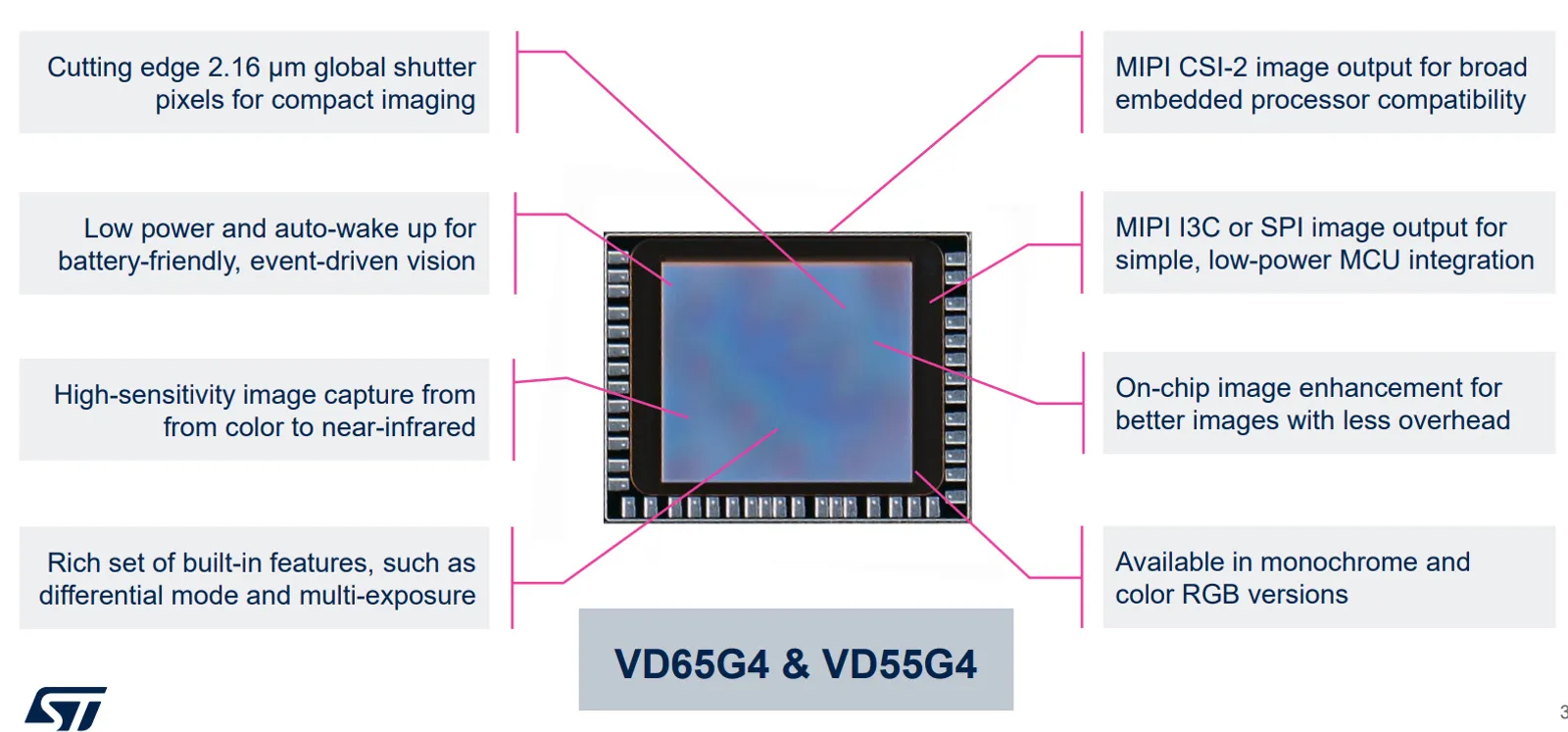
STMicroelectronics publicly announced two image sensors that signal where the industry is headed: the VD65G4 and VD55G4. Both are 0.56-megapixel global shutter sensors built for ultra-low-power, event-driven vision.
What makes them notable is the interface: I3C.
Why I3C Matters for Image Sensors
I3C isn't new, but its adoption in imaging applications is still ramping up. These sensors show why it belongs there.
Higher throughput. I3C supports data rates up to 12.5 Mbps in standard mode, with options for higher speeds in HDR mode. That's a meaningful step up from I2C, especially when you're moving image data or handling rapid event streams.
Reduced pin count. I3C includes in-band interrupts, which means the sensor can signal events without needing dedicated GPIO lines. For always-on vision systems where pin count and power matter, this is a structural advantage.
Lower power overhead. The protocol is designed for modern low-power applications. Combined with the sensors' event-driven architecture, you can keep the system in standby until something actually happens, then wake and respond efficiently.
Global Shutter + Event-Driven Architecture
The VD65G4 and VD55G4 use global shutter technology, which captures the entire frame simultaneously. This eliminates the rolling shutter distortion you see with fast-moving objects.
Pair that with event-driven processing and you get a sensor that only activates when it detects motion or change. The rest of the time, it's drawing microamps.
This combination works for robotics, machine vision, AR/VR, and any application where you need responsive imaging without burning through your power budget.
What This Means for Development
If you're working with I3C, these sensors are worth testing. The interface simplifies integration, reduces wiring complexity, and gives you room to scale data throughput as your application evolves.
For developers using tools like the Binho Nova, I3C host adapters make it straightforward to prototype and debug communication with these sensors. You can validate timing, inspect event handling, and confirm your interrupt logic before committing to production hardware.
The trend is clear: I3C is moving from ‘niche’ to ‘standard’ in applications where legacy I2C can't keep up. STMicroelectronics's sensors are another data point in that direction.
Technical Specs at a Glance
Resolution: 0.56 megapixels (800 x 700 pixels)
Shutter Type: Global shutter
Interface: I3C (up to 12.5 Mbps standard, HDR-capable)
Power Consumption: Ultra-low power in standby, event-driven wake
Target Applications: Always-on vision, robotics, AR/VR, machine vision
You can find the full technical details in STMicro's product brief and their announcement blog.
Final Thought
These low-power image sensors are enabling new types of always-on vision experiences on small, battery-powered devices that were previously not possible using legacy digital protocols. While the MIPI-CSI specification has been using I3C as the CCI (sideband management bus) for some time, these sensors highlight that I3C is well-suited for sending actual image sensor data to low-power, pin-constrained devices.