// ni usb-8451 upgrade
The USB-8451 is retired. Meet its replacement.
The NI USB-8451 is end-of-life and Windows-locked. The Binho Pulsar does the same I²C and SPI work far faster, adds UART, RS-485, GPIO, CAN-FD, and 1-Wire, and runs on every OS with free modern software. In stock today.
Ships worldwide · Windows, macOS, Linux · Royalty-free SDK · US-based engineering support

// still shipping
The NI USB-8451 is end-of-life, no longer sold. Pulsar is a current, in-stock, fully supported product you can buy and deploy today.
// far faster
USB 2.0 High Speed against the 8451’s USB Full Speed, with 1 MHz I²C and 50 MHz SPI, versus 250 kHz and 12 MHz. Roughly 40× the host bandwidth.
// runs everywhere
The NI-845x driver is Windows only. Mission Control 3 runs natively on every OS and from a browser tab, no LabVIEW required.
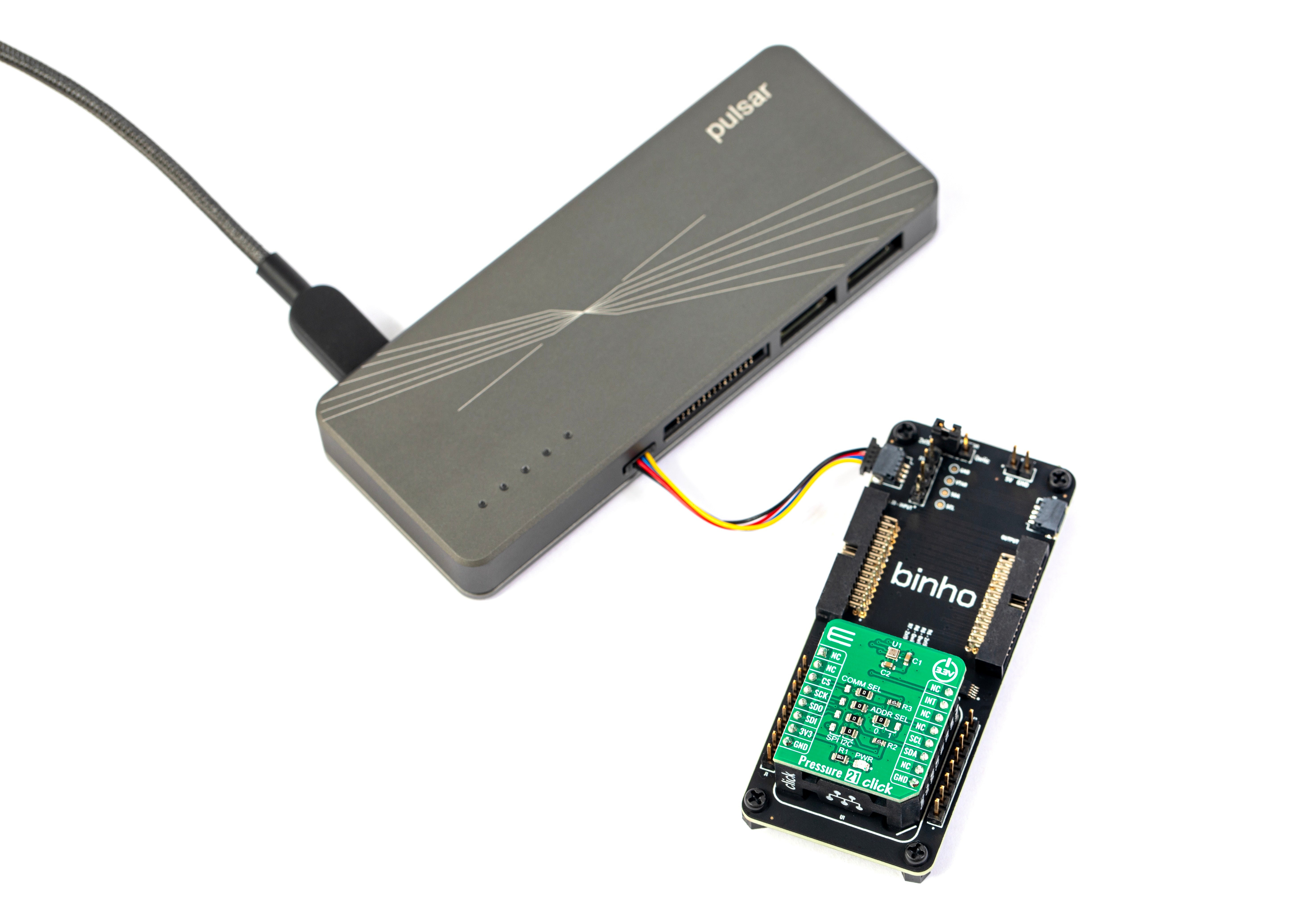
// i²c and spi
Talk to any I²C or SPI device.
I²C
1 MHz max- Controller and Target
- Two independent I²C buses
- 7-bit and 10-bit addressing
- Clock stretching
- Configurable pull-up resistors
- 16 KB max transaction size
SPI
50 MHz max- Controller and Target
- Up to 16 MHz (peripheral mode)
- All four SPI modes
- Up to 4× chip-select signals
- Configurable MSB / LSB
- 16 KB max transaction size
// head to head
A generation ahead, point for point.
| Binho Pulsar | NI USB-8451 | |
|---|---|---|
| // Hardware & protocols | ||
| Availability | In stock, shipping worldwide | Discontinued (end-of-life) |
| Host link | USB 2.0 High Speed, 480 Mbps | USB Full Speed, 12 Mbps |
| I²C | 1 MHz, programmable pull-ups | 250 kHz, external pull-ups |
| SPI clock | 50 MHz, four chip-selects | 12 MHz |
| Additional protocols | UART, RS-485, GPIO, CAN-FD, 1-Wire | 8 DIO lines only |
| Signal voltage | 1.2 to 3.3 V, level-shifted | 3.3 V only |
| DUT power | 1.2 to 3.3 V programmable rail | Fixed +5 V |
| Enclosure | Machined aluminum, 5× RGB LEDs | Plastic housing |
| // Software support | ||
| Operating systems | Windows, macOS, Linux, and browser | Windows only (NI-845x driver) |
| No-code GUI | Mission Control 3, free | None — script in LabVIEW / C |
| Memory programmer | Visual hex editor in Mission Control 3 | None |
| Web version available | Yes, try it here | No |
| Device SDK | Python · Java · C / C++ / C# | C · LabVIEW · .NET (NI-845x) |
| // Pricing | ||
| Price | $349 | Discontinued |
// trusted by engineering teams at













+ hundreds more
Ready to accelerate development?
or keep scrolling to learn more
// memory programming
Program EEPROM and SPI FLASH memories with ease.
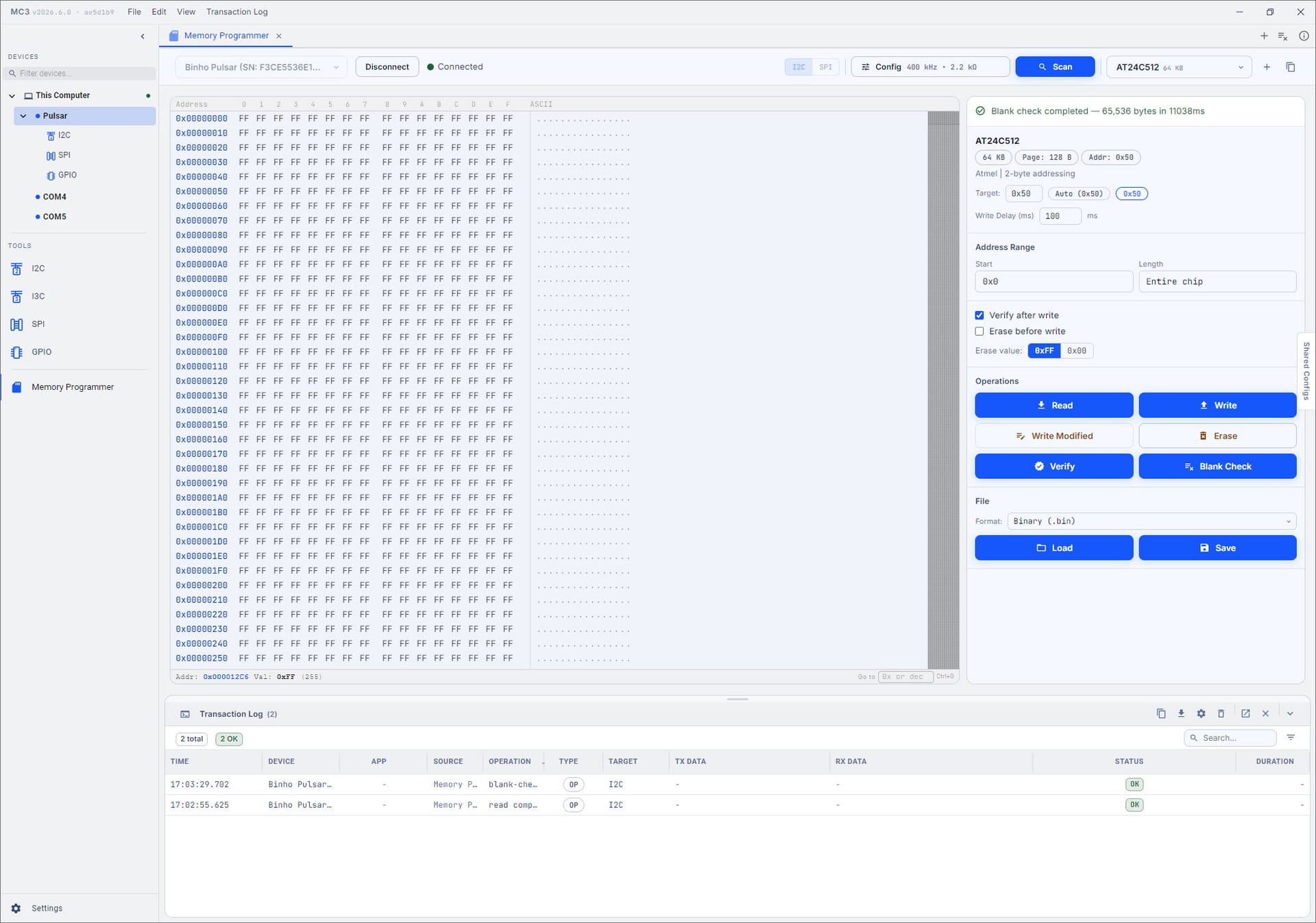
Reading and writing I²C EEPROMs and SPI flash is one of the top use-cases for host adapters. With the USB-8451 you script it yourself in LabVIEW or C. Mission Control 3’s Memory Programmer does it with a visual hex editor, per-chip presets, read / write / verify / blank-check / erase, and binary file load and save, no code required.
// every os
macOS included.
Runs natively on Windows, macOS, and Linux. The NI-845x driver for the 8451 is Windows only, so Mac and Linux users are stuck in a VM.
// in your browser
Or no install at all.
Program straight from a browser tab. Nothing to download, nothing to license, on any machine.
// try it now
Test drive it today.
Launch a simulated device in the web app and read, write, and verify right now, before your Pulsar even ships.
// see it in action
Drive I²C without writing code.
Mission Control 3 turns bus work into point-and-click. Compose a transaction and run it, then chain a whole sequence and fire it in one go.
// point and click
Run a transaction with a click.
Compose an I²C read or write in the GUI and send it straight to your device.
// sequences
Chain them into a sequence.
Line up a series of transactions and run them together, repeatable and ready to replay whenever you need them.
// get mission control 3
Get Mission Control 3.
Try it right now in your browser with a simulated device, no hardware required, or install the desktop app for Windows, macOS, or Linux.
Launch in your browser// or download the desktop app · v2026.8.1
// in the box
Everything you need. Running in under a minute.
Every cable, adapter, breakout, and mounting accessory ships in a protective case. Plug in over USB-C and you are on the bus, with no extra parts to source.
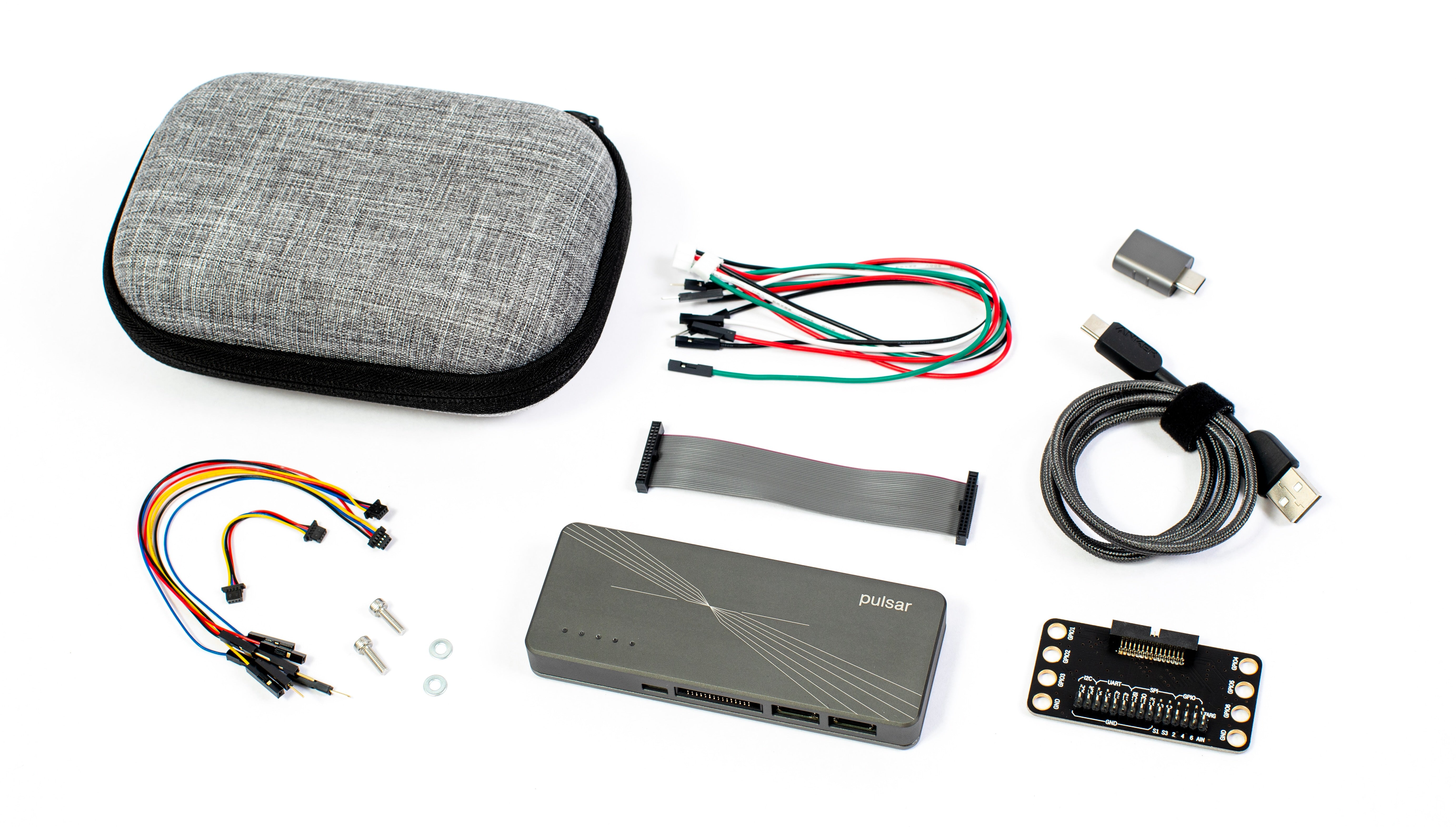
1× Binho Pulsar USB Host Adapter
Differential Port Kit
- 1× 4-pin JST PH cable with female headers
- 1× 4-pin JST PH cable with male headers
Dedicated I2C Port Kit
- 1× 4-pin JST SH (Qwiic-compatible) to 4-pin JST SH cable
- 1× 4-pin JST SH (Qwiic-compatible) cable with male headers
- 1× 4-pin JST SH (Qwiic-compatible) cable with female headers
Multifunction Port Breakout Kit
- 1× 30-conductor IDC ribbon cable
- 1× ribbon cable to 2.54 mm pitch header breakout board
USB Kit
- 1× USB Type-C to Type-A cable
- 1× USB Type-A to Type-C adapter
Mounting Kit
- 2× mounting screws
- 2× washers
1× Custom protective zippered carry case
Supercharge embedded development!
// and there's more
Pulsar goes beyond I²C and SPI.
The USB-8451 handles I²C, SPI, and eight DIO lines. Pulsar keeps going, so the next board that needs another bus does not cost you another tool.
// ai native
Ready for your agents.
An open, fully documented SDK lets an AI agent drive real silicon over I2C, SPI, UART, RS-485, and CAN-FD, learning the whole API from a single prompt. It is the kind of modern workflow a legacy adapter was never built for.






// the prompt
Use the Pulsar to scan the I2C bus, read the EEPROM at 0x50, and tell me what is stored there.
One sentence in. The agent learns the API, runs it on real silicon, and reports back.
// faq
Common questions.
Is the NI USB-8451 still available?
No. The USB-8451 is end-of-life and no longer sold, and NI directs buyers to the newer USB-8452. The Binho Pulsar is a current, in-stock, fully supported product, and a modern upgrade from either.
Is the Binho Pulsar a good replacement for the NI USB-8451?
Yes. Pulsar does the same I²C and SPI work far faster: 1 MHz I²C and 50 MHz SPI over a 480 Mbps USB 2.0 High Speed link, versus 250 kHz, 12 MHz, and USB Full Speed on the 8451. It adds UART, RS-485, GPIO, CAN-FD, and 1-Wire, built-in level shifting from 1.2 to 3.3 V, and free cross-platform software, in a machined-aluminum enclosure.
Do I need Windows or LabVIEW to use the Pulsar?
No. The NI-845x driver for the USB-8451 runs on Windows only and is built around the LabVIEW / C ecosystem. Mission Control 3 is a free app for Windows, macOS, and Linux, with a no-code GUI and Python, Java, and C/C++/C# SDKs, plus a browser version. No LabVIEW, no NI license.
Does the Pulsar need external pull-up resistors for I²C like the 8451?
No. The USB-8451 removes its I²C circuit protection so you must add external pull-ups. The Pulsar has configurable on-board pull-up resistors, so you can talk to most I²C devices straight out of the box.
What does the Pulsar add beyond I²C and SPI?
UART, RS-485, six dedicated GPIO, CAN-FD, and 1-Wire, plus a programmable 1.2 to 3.3 V DUT-power rail and a visual memory programmer for EEPROM and flash. The USB-8451 offers I²C, SPI, and eight general-purpose DIO lines.
Does the Pulsar support MIPI I3C?
No. The Pulsar covers SPI, I²C, UART, and RS-485, but not I3C. If you need MIPI I3C, reach for the Binho Supernova: it adds I3C alongside I²C, SPI, UART, and GPIO, and runs on the very same Mission Control 3 software and SDKs as the Pulsar, so moving between them is seamless.
Explore the Binho SupernovaMove ahead with Pulsar.
A modern, in-stock replacement: faster, cross-platform, and ready for every bus on your board.
Buying for a team? Request a quote