// application note
AN0009 Managing a CMIS optical module over I3C with the Binho Supernova
The OSFP-XD connector already permits I3C single data rate at 12.5 Mbit/s on the same two pins that carry the required 400 kbit/s I2C, and silicon vendors are shipping CMIS targets that use it. No published revision of CMIS specifies an I3C management interface, so a host driving one is following a private derivation rather than a standard. This application note brings up a CMIS module over I3C single data rate from a Binho Supernova, separates what carries over from the I2C binding unchanged from what is a genuine upgrade and what is not specified at all, and supplies a command that establishes which of two incompatible address wrap rules a given target implements.
- Products
- Binho Supernova
- Protocols
- I3C
- Topics
- CMIS
- Revision
- Rev 1.0 · November 6, 2026
// outcomes
What you'll walk away with
By the end of this document a reader with the hardware in front of them will have brought an I3C CMIS target onto a bus by dynamic address assignment, read its identity and validated its Page 00h checksum over I3C single data rate private transfers, established which address roll-over rule it implements, and received an in-band interrupt from it with no interrupt pin connected.
The document covers a level A binding, meaning I2CMCI semantics preserved byte for byte over I3C private transfers, which is what NXP shipped and what will exist in laboratories for the next two years. A native I3CMCI adopting SPIMCI's three dimensional addressing and large transfers is discussed in Section 4 but is not implemented here, because it requires OIF work that has not happened.
AN0008 covers the register model itself and is a prerequisite. This document assumes it.
// background
Background
The connector already allows it. OSFP-XD Revision 1.1 section 10.5.1 lists optional I3C single data rate at 12.5 Mbit/s on the same SCL and SDA pins that carry the required 400 kbit/s I2C. An I3C managed module is legal at the connector today.
Silicon vendors are already building to it. NXP application note AN15071 ships a working CMIS 5.3 target over I3C on the MCX N947 at 12.5 Mbit/s. To exercise it, NXP wrote USB-to-I3C bridge firmware for a second development board and a bespoke host executable, which is the gap this note fills with a shipping adapter.
What does not exist is a specification saying what correct looks like. This note is therefore as much about the decisions an I3C binding forces as about the procedure, because a reader adopting one has to make those decisions and write them down.
// applicable devices
Applicable devices
| Item | Role | Basis |
|---|---|---|
| Binho Supernova | Host adapter, I3C controller | Section 9, every command in Section 6 |
| NXP FRDM-MCXN947 running the Binho CMIS target firmware | I3C CMIS target | Section 9, enumeration through checksum |
| NXP MCX N947 running AN15071 firmware | I3C CMIS target | Not exercised for this note |
| Any I3C CMIS target at static address 0x50 | Target | Not exercised for this note |
The Binho Pulsar has no I3C interface. This note requires a Supernova. The utility refuses
--transport i3con a Pulsar rather than failing later in a way that looks like a wiring fault.
The rows marked as not exercised are not claims. The mapping in Section 4 is derived from OIF-CMIS-05.3 and 05.4, from MIPI I3C Basic v1.1.1, and from OSFP-XD Revision 1.1. Section 9 reports what we ran and against what. We have not run this note against a commercial optical module, and no result here should be read as one.
// what's covered
What's covered in the note
- 01 Introduction
- 02 Required equipment and software
- 03 Two levels of binding, and which one you are building
- 04 The mapping, mechanism by mechanism
- 05 Every CMIS module answers at 0x50
- 06 Procedure
- 07 The in-band interrupt is the part worth building for
- 08 What the analyzer adds
- 09 Measured results
- 10 Troubleshooting
The full procedure, measured results, and reference code are in the PDF and the assets archive.
// materials
What you'll need
 Binho Supernova USB host adapter for I3C, I2C, SPI & UART View product
// our edge
We don't just follow the I3C spec.
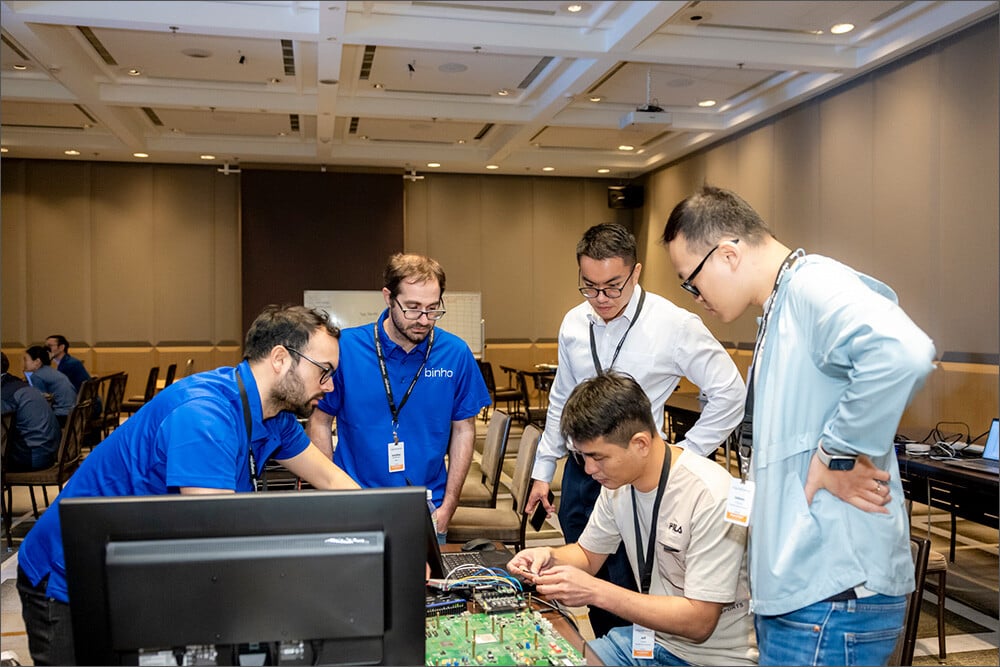
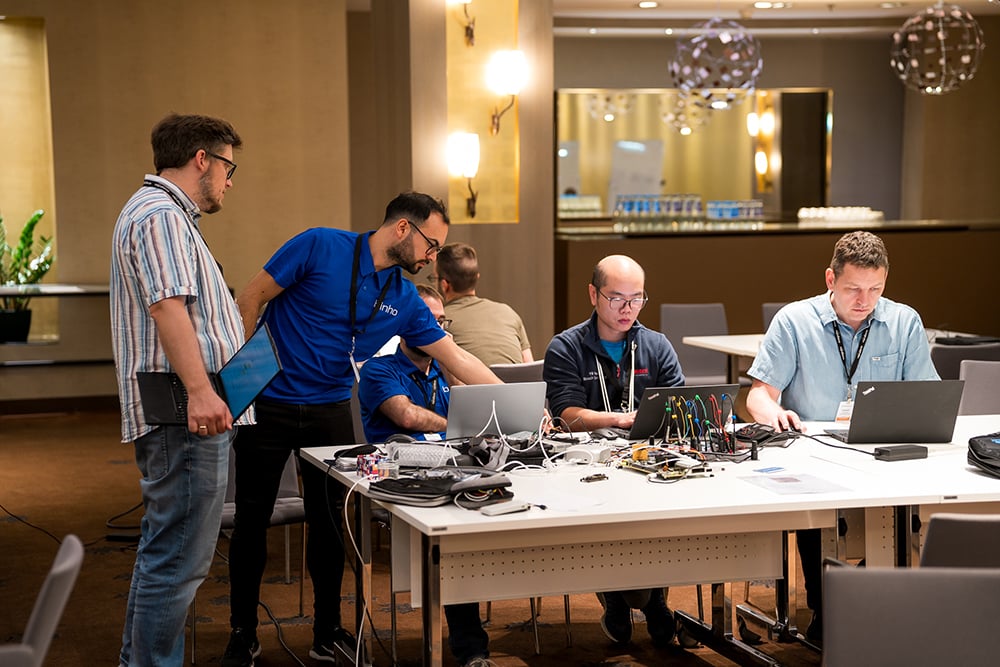
We don't watch from the sidelines. Plugfest after plugfest, our team is in the room where vendor I3C implementations come together — finding edge cases, debugging quirks, and validating real silicon against the spec.
// track record
We've been doing this for years.
Long enough to know where the gotchas live.

// 01 · standards
We help write the spec.
Binho is a MIPI Alliance Contributor Member, actively shaping I3C — a foundational protocol for cutting-edge embedded systems.
// 02 · tools
We build the tools.
200+ semiconductor companies use Binho tools to develop, validate, and ship devices with I3C protocol support.
// 03 · plugfests
We prove it in the field.
We've verified our tools at the past 5 MIPI I3C Plugfests — and helped others verify theirs too.
// trusted by engineering teams at


+ hundreds more
// related notes
Related Application Notes
// newsletter
Get new application notes
New notes, firmware releases, and tool updates from Binho. No spam, unsubscribe anytime.
Put it on the bench
Every step in AN0009 was run on the Binho Supernova. Get the hardware to reproduce it, or talk to our engineers about your I3C bring-up.