// application note
AN0019 Building a CMIS I3C target on a Microchip dsPIC33AK and testing it with the Binho Supernova
A CMIS optical module answers its host as an I3C target, and the host reads it the way an I2C host does: write the byte address, repeated START, read. On the dsPIC33AK256MPS306 I3C peripheral the interrupt for that write arrives after the read header has already been answered, so a target that arms its reply from it NACKs every such read. This note shows where the byte address is available in time, how the firmware arms from the receive DMA instead, and the numbers measured from a Binho Supernova: 60 of 60 reads at 4 to 128 bytes, 300 of 300 with in-band interrupts on, after a reset too. It supplies the host-side test script and lists the behaviors of the peripheral and driver that a port has to plan for.
- Products
- Binho Supernova
- Protocols
- I3C
- Topics
- CMIS
- Revision
- Rev 1.0 · November 6, 2026
// outcomes
What you'll walk away with
- A CMIS register model on the dsPIC33AK: paging, the section 8.2.15 unsupported-page
override, the Appendix B.1.2 wrap inside a 128-byte segment, and an IBI that carries the
Flags Summary byte
00h:4. - Answering write + Sr + read (combined) and write, STOP, read (split) at 2.5 MHz push-pull.
- Dynamic address assignment, RSTDAA, and the Direct GET CCCs.
- A host script that runs every check in this note from a Supernova.
Not covered: CDB, firmware download, HDR modes, and the module-side meaning of the CMIS control registers. The register image is static except for the page select and the bytes the host writes.
// background
Background
A CMIS module exposes a 256-byte window, Lower Memory plus one 128-byte page of Upper
Memory, selected by a page byte at 00h:127. Over I2C the host writes a byte address and
then reads with a repeated START. The I3C management interface being defined for CMIS keeps
that access pattern, so a module built on an I3C target peripheral has to answer a read
whose byte address arrived a few bit times earlier, in the same transfer.
That is easy when the peripheral hands each byte to firmware as it arrives. The dsPIC33AK256MPS306 I3C peripheral is command and response based instead: a received transfer is reported once, as a response, and a read is answered by a transmit command that must already be valid when the read header arrives. This note is about making those two meet.
// applicable devices
Applicable devices
| Family | Example parts | Identifier | Basis |
|---|---|---|---|
| dsPIC33AK MPS with I3C | dsPIC33AK256MPS306 (EV02E57A DIM) | PID 02 36 43 4D 49 53 |
Tested |
| dsPIC33AK MP without I3C | dsPIC33AK512MPS506 and family | - | Not applicable: no I3C peripheral |
| Other parts with the same I3C peripheral | - | - | Not tested |
// what's covered
What's covered in the note
- 01 Introduction
- 02 System overview
- 03 Hardware setup
- 04 Software setup
- 05 Target firmware design
- 06 Procedure
- 07 Measured results
- 08 Troubleshooting
The full procedure, measured results, and reference code are in the PDF and the assets archive.
// materials
What you'll need
 Binho Supernova USB host adapter for I3C, I2C, SPI & UART View product
// our edge
We don't just follow the I3C spec.
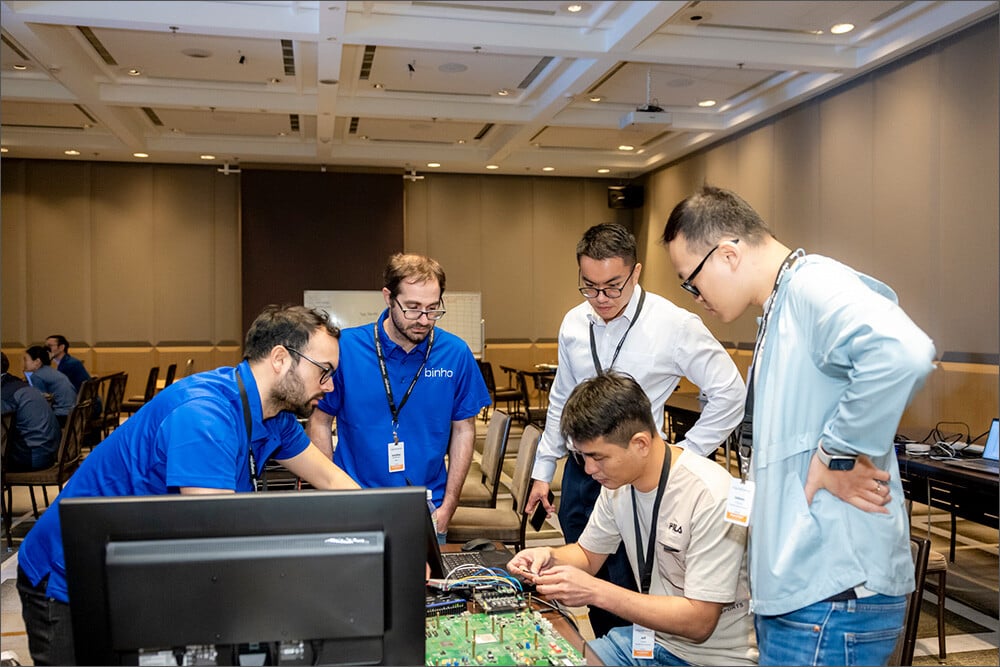
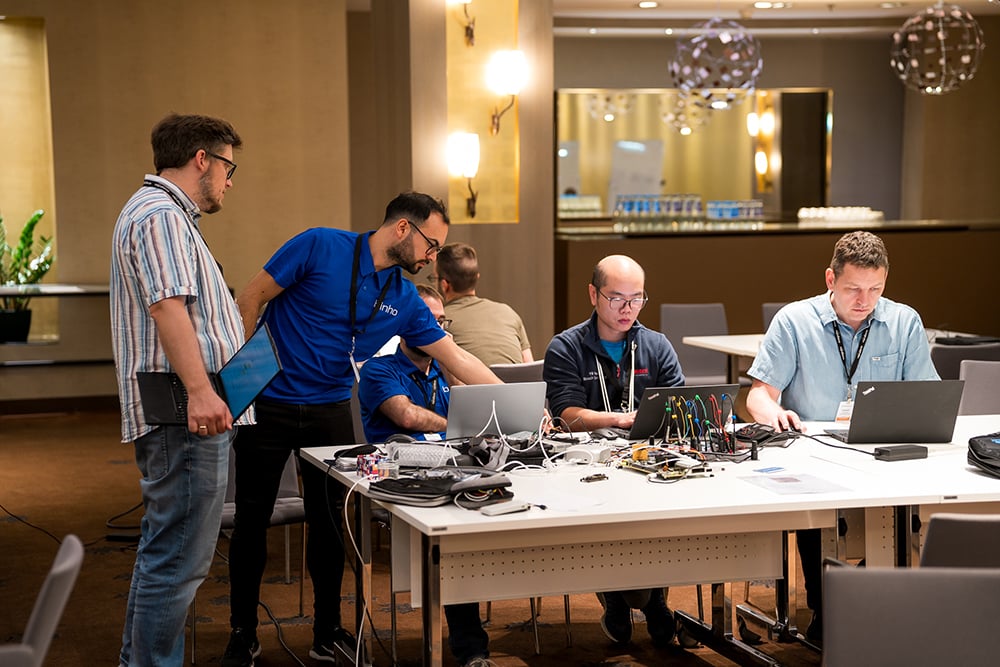
We don't watch from the sidelines. Plugfest after plugfest, our team is in the room where vendor I3C implementations come together — finding edge cases, debugging quirks, and validating real silicon against the spec.
// track record
We've been doing this for years.
Long enough to know where the gotchas live.

// 01 · standards
We help write the spec.
Binho is a MIPI Alliance Contributor Member, actively shaping I3C — a foundational protocol for cutting-edge embedded systems.
// 02 · tools
We build the tools.
200+ semiconductor companies use Binho tools to develop, validate, and ship devices with I3C protocol support.
// 03 · plugfests
We prove it in the field.
We've verified our tools at the past 5 MIPI I3C Plugfests — and helped others verify theirs too.
// trusted by engineering teams at


+ hundreds more
// related notes
Related Application Notes
// newsletter
Get new application notes
New notes, firmware releases, and tool updates from Binho. No spam, unsubscribe anytime.
Put it on the bench
Every step in AN0019 was run on the Binho Supernova. Get the hardware to reproduce it, or talk to our engineers about your I3C bring-up.