// application note
AN0016 Reading a DDR5 SPD hub and driving Corsair RGB over the DIMM sideband with the Binho Supernova
A DDR5 module carries an SPD5118 hub on its sideband bus: the SPD NVM, a temperature sensor, and a gateway to other devices on the module. This application note reads that hub from a Binho Supernova, in I2C mode and in I3C mode, and drives the RGB lighting controller of a Corsair DDR5 module, which sits behind the hub. It gives the register sequences, the I3C rates that returned correct data on one bench, a failure in I3C register writes that hung the bus until the module was power-cycled, and two Python scripts on pycosmicsdk.
- Products
- Binho Supernova
- Topics
- DDR5 SPD
- Revision
- Rev 1.0 · November 6, 2026
// outcomes
What you'll walk away with
This document covers:
- identifying the SPD5118 hub, reading its temperature sensor, and reading the 1 KB SPD NVM
- reading the PMIC status, read-only
- switching the hub to I3C with SETAASA, reading it in SDR, and returning it to I2C with RSTDAA
- the I3C rates that returned correct data on this bench, and the one that did not
- the Corsair RGB controller behind the hub: taking it out of firmware-update mode, setting colours per LED, and starting a hardware effect
It does not cover writing the SPD NVM, writing hub registers over I3C (Section 5.3 explains why), in-band interrupts from the hub (attempted, none received), PEC, or access to the RGB controller with the hub in I3C mode (not tried).
// background
Background
A DDR5 DIMM exposes a two-wire sideband (HSCL, HSDA) separate from the memory bus. On it the SPD5118 hub answers first; it holds the module's SPD data, reports temperature, and forwards traffic to other devices on the module's local bus, such as the PMIC and, on lighting modules, an RGB controller. The hub starts in I2C mode and can be switched to I3C.
This note covers reading the hub and those devices from a host adapter, without a motherboard.
// applicable devices
Applicable devices
| Role | Part | Identifier | Basis |
|---|---|---|---|
| Host adapter | Binho Supernova | hardware revision C, firmware 4.6.1 | measured, this document |
| SPD hub | SPD5118 on the module below | MR0-1 51 18, MR2 revision 0x14 |
measured, this document |
| PMIC | PMIC on the module below | address 0x48 |
read-only status, measured |
| RGB controller | Corsair Vengeance RGB RS DDR5, 6 LEDs | VID 0x1B1C, PID 0x0B00 in firmware-update mode, 0x0B01 in normal mode |
measured, this document |
| Module | Corsair CMG16GX5M2E6000Z36 (one DIMM of the kit) |
SPD byte 2 0x12 (DDR5), byte 3 0x02 (UDIMM) |
measured, this document |
| Other SPD5118 modules | any DDR5 UDIMM or SODIMM | MR0-1 51 18 |
Sections 5.1 and 5.2 follow JESD300-5; not tested beyond one module |
| Other Corsair DDR5 RGB modules | other PIDs | not tested |
// what's covered
What's covered in the note
- 01 Introduction
- 02 System overview
- 03 Hardware setup
- 04 Software setup
- 05 Registers and protocol
- 06 Procedure
- 07 Measured results
- 08 Troubleshooting
The full procedure, measured results, and reference code are in the PDF and the assets archive.
// materials
What you'll need
 Binho Supernova USB host adapter for I3C, I2C, SPI & UART View product
// our edge
We don't just follow the I3C spec.
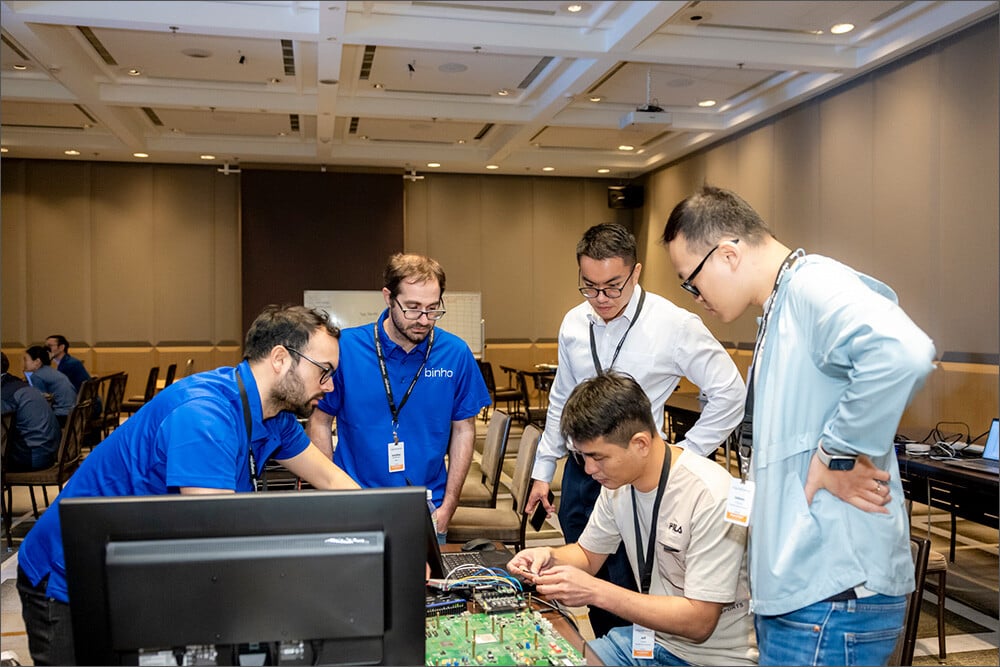
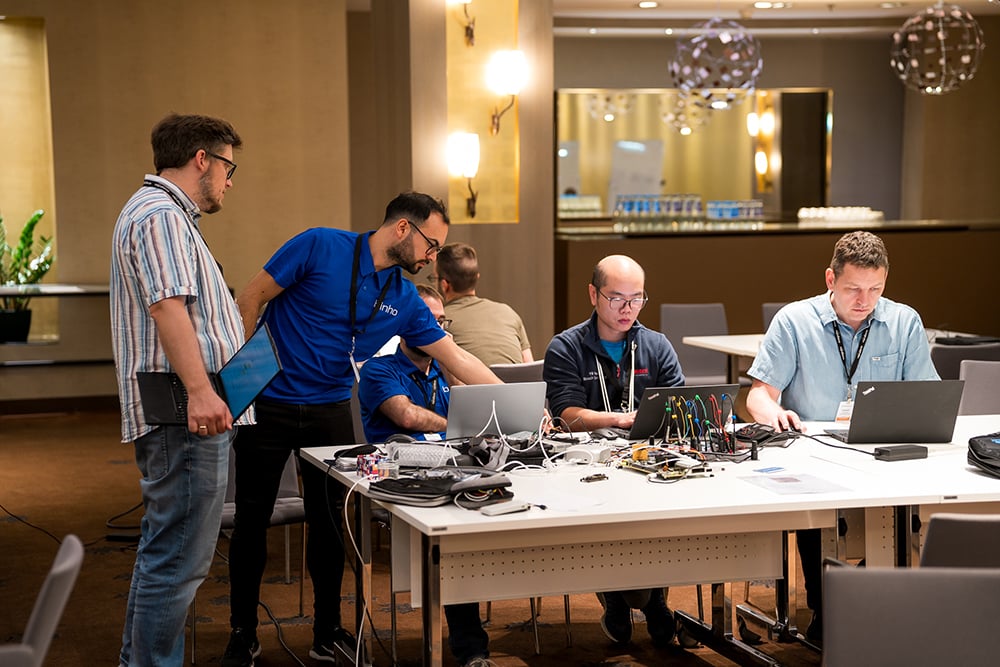
We don't watch from the sidelines. Plugfest after plugfest, our team is in the room where vendor I3C implementations come together — finding edge cases, debugging quirks, and validating real silicon against the spec.
// track record
We've been doing this for years.
Long enough to know where the gotchas live.

// 01 · standards
We help write the spec.
Binho is a MIPI Alliance Contributor Member, actively shaping I3C — a foundational protocol for cutting-edge embedded systems.
// 02 · tools
We build the tools.
200+ semiconductor companies use Binho tools to develop, validate, and ship devices with I3C protocol support.
// 03 · plugfests
We prove it in the field.
We've verified our tools at the past 5 MIPI I3C Plugfests — and helped others verify theirs too.
// trusted by engineering teams at


+ hundreds more
// related notes
Related Application Notes
// newsletter
Get new application notes
New notes, firmware releases, and tool updates from Binho. No spam, unsubscribe anytime.
Put it on the bench
Every step in AN0016 was run on the Binho Supernova. Get the hardware to reproduce it, or talk to our engineers about your I3C/I2C bring-up.