// usb-to-spi adapter
The USB-to-SPI adapter, done right.

The Binho Pulsar interfaces your PC with any SPI bus: quality hardware, desktop software worth using, and a modern SDK.
Ships worldwide · Windows, macOS, Linux · Royalty-free SDK · US-based engineering support
// capabilities
Everything a host adapter should do. And more.
The Pulsar is the SPI controller on your bus, driven from your PC over USB. No firmware, no target board, no microcontroller in the loop.
// high speed
50 MHz transfers
A 50 MHz SPI controller over a 480 Mbps USB link keeps big flash dumps and register reads fast.
// read / write
Full-duplex I/O
Clock out and read in on the same transaction, byte for byte, exactly as the datasheet expects.
// modes + cs
Every mode and CS
All four CPOL/CPHA modes and up to four chip-selects, so several devices share one adapter.
// any peripheral
Any SPI peripheral
Flash, ADCs, DACs, displays, sensors. Bring up and validate any SPI device.
- Max clock
- 50 MHz (Controller) / 16 MHz (Peripheral)
- SPI modes
- 0, 1, 2, 3
- Chip-selects
- Up to 4
- Bit order
- MSB / LSB first
- Role
- Controller & Peripheral
- Max transfer size
- 16 KB
- Logic levels
- 1.2–3.3 V
- Host interface
- USB 2.0 High Speed
- Bandwidth
- 480 Mbps
- Connector
- USB Type-C
- DUT power
- 1.2–3.3 V, programmable
- GPIO
- 6 dedicated pins
- Other protocols
- I²C · UART · RS-485 · CAN-FD · 1-Wire
// interfaces
Drive it the way you work.
Point and click, script it, or build it into your own tools. One adapter, three first-class interfaces, all on the same hardware.
// point & click
Mission Control 3
Compose transfers, program flash, and read results in a desktop app or right in your browser. No code required.
// automate
Python
Official PyPI packages put the whole device in your test scripts and CI, in the language your team already automates with.
// integrate
Cosmic SDK
Native SDKs to embed the Pulsar in production test systems and factory software, across four languages.
// mission control 3
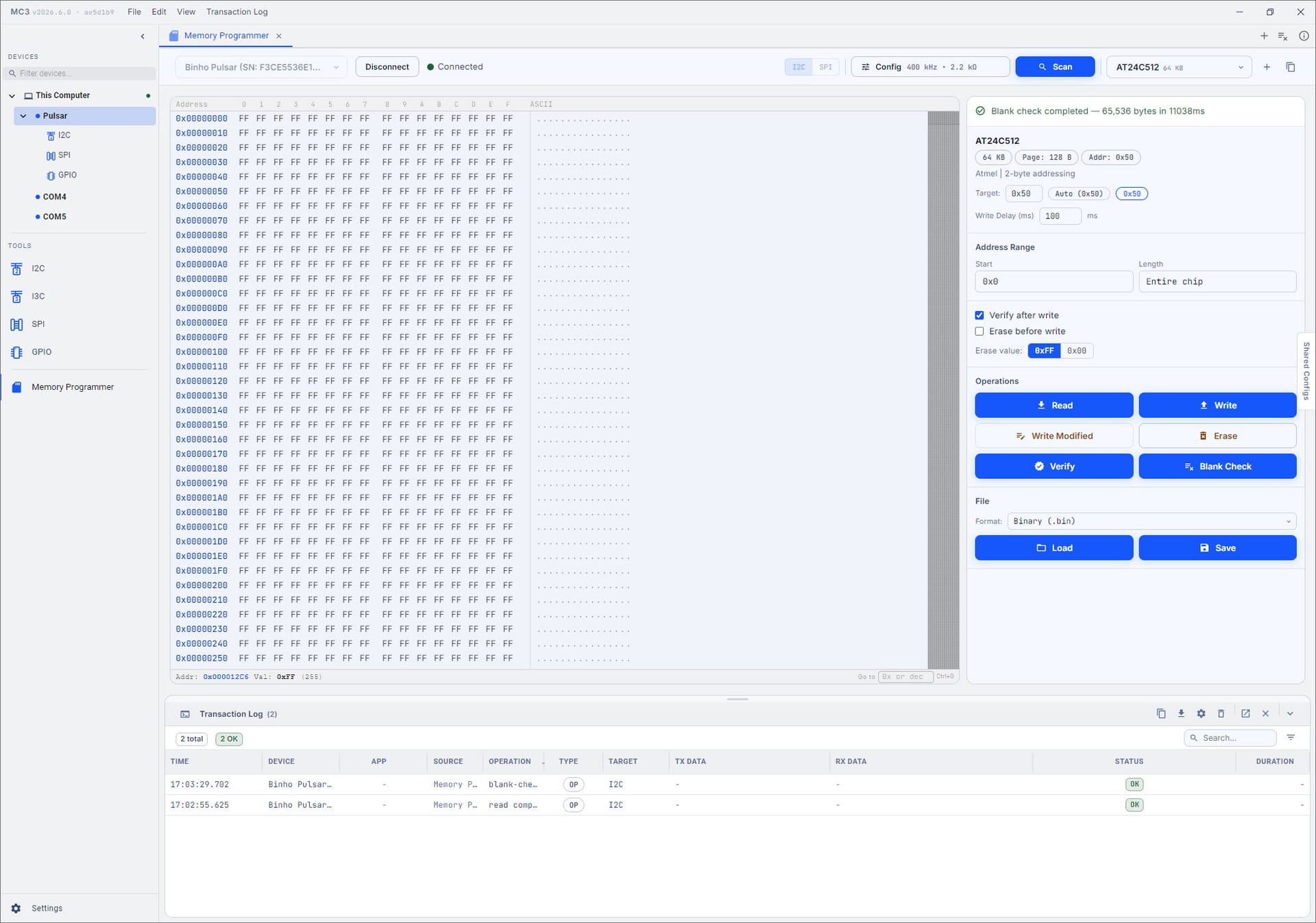
Point, click, and program. No code.
Use our cross-platform desktop app for point-and-click SPI transfers and reading/writing SPI flash. Runs on Windows, macOS, Linux, and even in the browser.
// ai agents
Give your AI agent hands on real hardware.
Point Claude, or any agent, at the Pulsar’s open SDK. It drives the SPI bus, reads and writes flash and registers, and verifies on real silicon, not a datasheet.






// the prompt
Use the Pulsar to read the JEDEC ID from the SPI flash and dump the first 256 bytes.
One sentence in. The agent learns the API, runs it on real silicon, and reports back.
// get the pulsar
Binho Pulsar
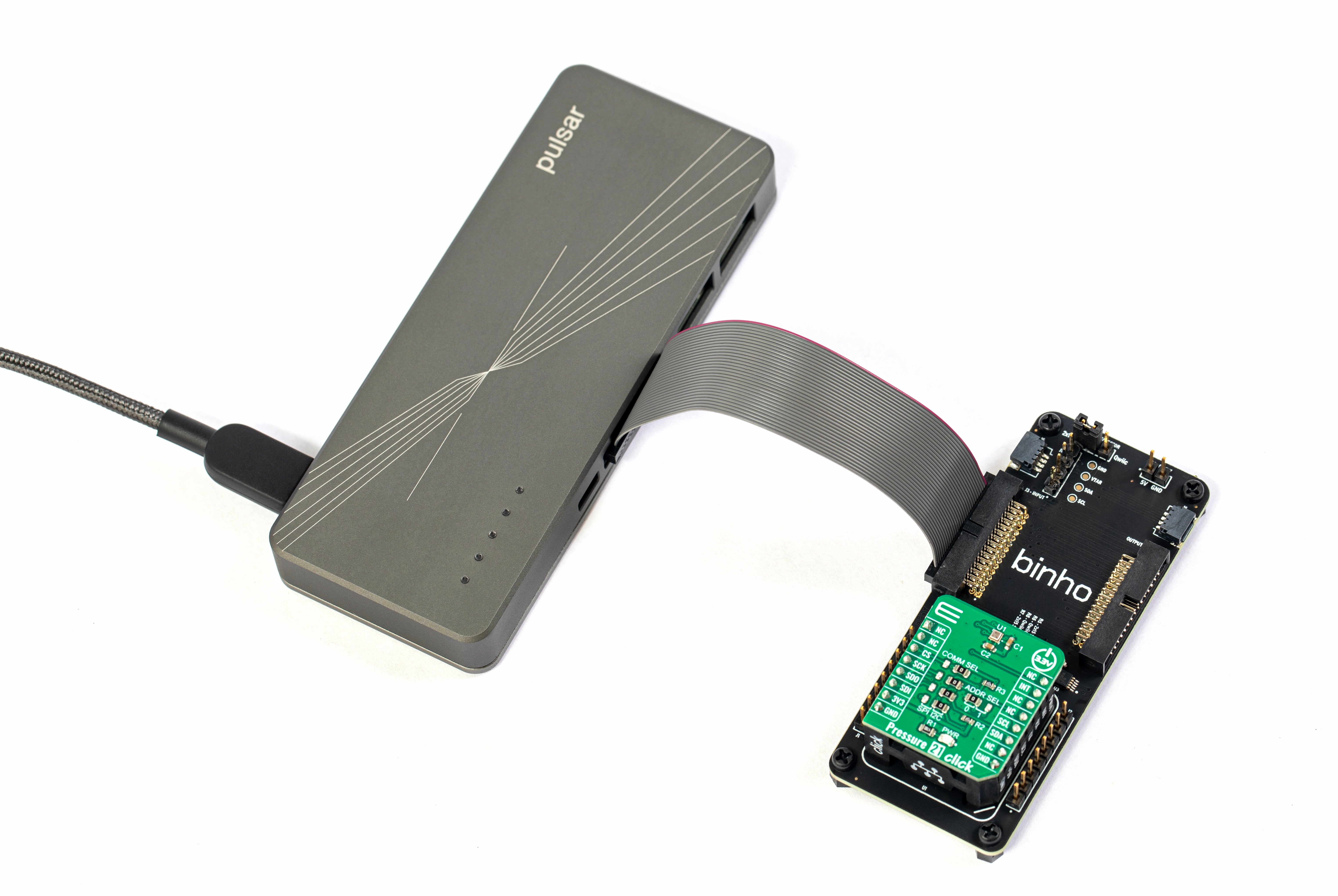
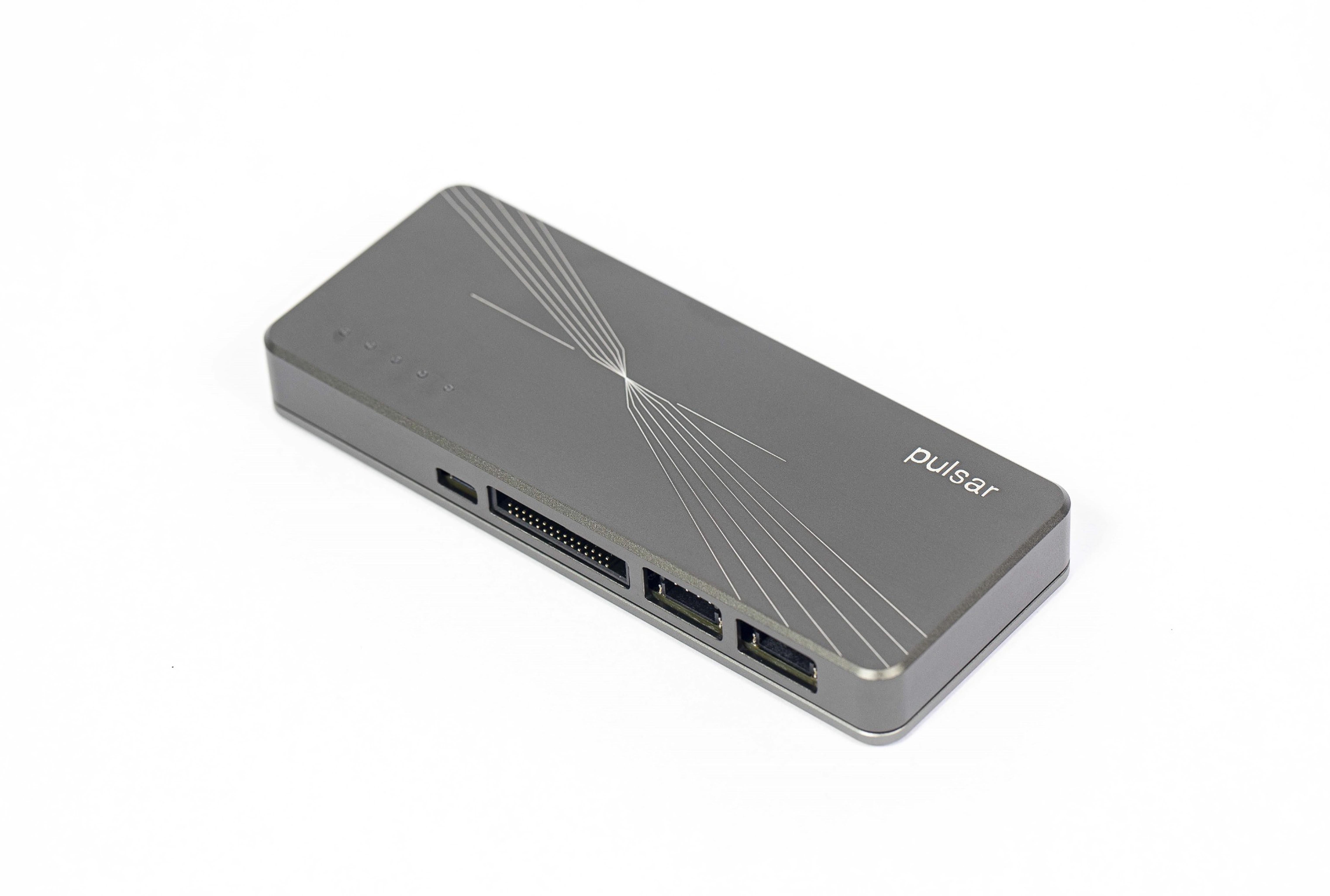
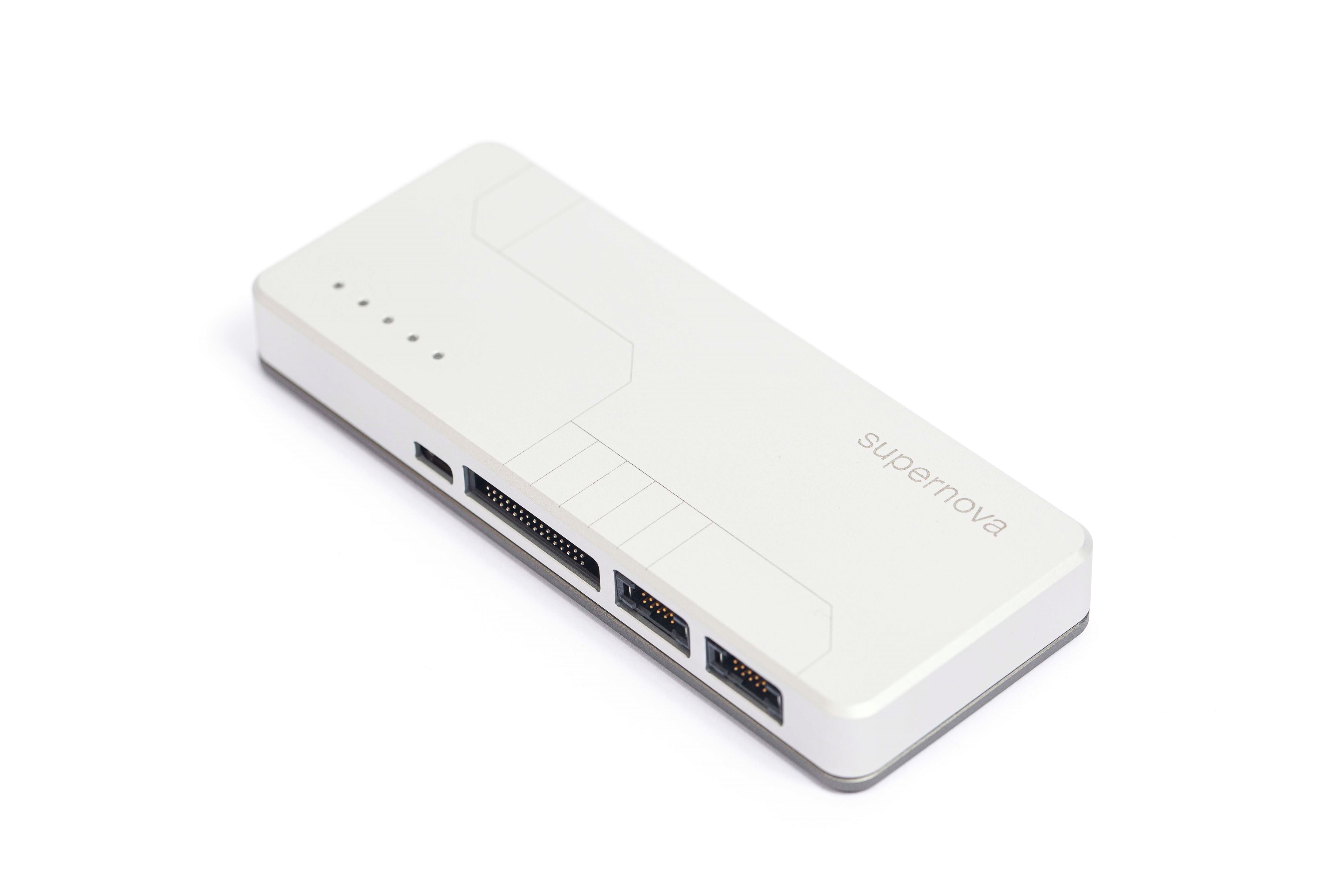
The wide-protocol USB host adapter: six digital buses on dedicated pins, a USB 2.0 High Speed link to your PC, in a machined-aluminum enclosure.
// in the box
- Binho Pulsar adapter
- Dedicated I²C port kit
- Differential port kit (RS-485 / CAN-FD)
- Multifunction breakout kit
- USB-C cabling & mounting hardware
- Protective carry case
// hardware highlights
Engineered down to the details.
Small hardware decisions that make the Pulsar quick to bring up and easy to design in.
Built-in mounting holes
Bolt it straight into a test fixture or production jig.
Integrated Voltage Translation
1.2 to 3.3 V on-board. No external level-shifting circuitry.
Up to four chip-selects
Drive several SPI devices on one bus from a single adapter.
Programmable DUT power
Set the downstream supply to your target, powered over USB.
// usb-to-spi, explained
How a USB-to-SPI adapter works.
A USB-to-SPI adapter lets your PC talk directly to an SPI bus. Plug it into a USB port and it becomes the SPI controller: your computer composes the transfers, the adapter clocks them out on SCLK, MOSI, and CS and reads MISO back, and the results come straight to your screen. No microcontroller to program, no eval board to wire up, and no firmware to maintain.
// key considerations
Throughput, not just clock speed
A 50 MHz rating means little if the USB layer adds latency to every transfer. Bit-banged adapters crawl on big flash reads and dumps.
Get the SPI mode right
CPOL and CPHA have to match the device. The wrong mode reads pure garbage, so the adapter needs all four.
Chip-select control
Real boards have several SPI devices. You need multiple chip-selects, and control over their timing.
Logic levels
Modern parts run at 1.8 V or lower. A fixed-voltage adapter means adding level shifters, or risking a damaged target.
The software is the product
Most adapters treat software as an afterthought: a thin driver, Windows-only, or nothing at all. A real GUI and SDK save more time than any spec.
Hidden license fees
Some tools gate protocols or features behind per-seat or per-protocol licenses. Weigh the total cost, not the sticker price.
// comparison
Head-to-head against the legacy tools.
Coming from a Total Phase Cheetah or Aardvark, or an NI USB-845x? We ran the side-by-side, feature for feature and license for license.
// vs total phase
The Total Phase alternative
Replacing a Cheetah, Aardvark, or Promira? One modern adapter, with 50 MHz SPI, free cross-platform software, and none of the per-protocol licenses.
See the comparison// vs ni
The NI USB-845x alternative
Moving off the NI USB-8451 or USB-8452? Match the 50 MHz SPI, get modern cross-platform software and a royalty-free SDK, with no NI-845x licensing to manage.
See the comparison// trusted by engineering teams at












+ hundreds more
// faq
Common questions.
Can I program SPI flash with it?
Yes. Mission Control 3 has a Memory Programmer that reads, writes, verifies, blank-checks, and erases SPI NOR flash (and I²C EEPROM), with a visual hex editor, per-chip presets, and binary file load and save. The same operations run from the Python SDK, so the script that flashes one board on your desk also runs your production line.
What SPI clock speeds and modes are supported?
The Pulsar is an SPI controller up to 50 MHz, with all four SPI modes (CPOL/CPHA 0–3), configurable bit order, and up to four chip-selects, so several devices can share one adapter. It also runs as an SPI peripheral up to 16 MHz.
How do I control it: GUI, Python, or C?
All three. Mission Control 3 is a no-code GUI on Windows, macOS, Linux, and the browser. The Python packages on PyPI drop it into your test scripts and CI. And the Cosmic SDK gives you native C, C#, C++, and Java for production tools, all driving the same hardware.
Software and SDK downloads Can I use it for hardware-in-the-loop testing?
Yes. Drive the target’s SPI bus from the GUI or code, replay repeatable transfer sequences, and read back real state, then wire it into CI to validate every build against real hardware. The Pulsar can also act as an SPI peripheral (up to 16 MHz), emulating a device for controller-side validation.
Can an AI agent use it as an SPI interface?
Yes. The Pulsar ships an open, documented SDK, so Claude or any agent can drive the SPI bus, read and write flash and registers, and verify against a real target. It is hardware-in-the-loop access for agentic embedded development.
See AI-native development Does it work on macOS and Linux?
Yes. Mission Control 3 and the SDKs run natively on Windows, macOS, and Linux, and there is a browser web app, so your test setup is not locked to one operating system.
The USB-to-SPI adapter,
done right.
Order the Binho Pulsar today. In stock, shipping worldwide, and backed by US-based engineering support.
Buying for a team? Request a quote